Why VR Cam Viewers Stay 3x Longer Than Traditional Cam Viewers: The Presence Lock Effect Explained
Here's a question that's been buzzing in the adult entertainment industry: Why do VR cam viewers stay in sessions 2–3x longer than traditional 2D cam viewers? The answer lies in a fascinating...
In this article
- 01What Is the "Presence Lock" Effect?
- 02The Science Behind Why Viewers Stay Longer
- 03VR Cams vs Traditional Cams: The Numbers
- 04The "Cognitive Exit Cost" — Why It's Hard to Leave VR
- 05What This Means for Performers
- 06What This Means for Viewers
- 07The Future: Where VR Camming Is Headed
- 08📚 Related Articles on xMonter
- 09Final Thoughts
Here's a question that's been buzzing in the adult entertainment industry: Why do VR cam viewers stay in sessions 2–3x longer than traditional 2D cam viewers? The answer lies in a fascinating psychological phenomenon we call the "Presence Lock Effect" — and it's changing everything about how performers connect with their audiences.
Whether you're a viewer curious about VR cams, a performer looking to understand engagement, or just someone fascinated by the psychology of immersion, this deep dive will explain exactly why putting on a VR headset transforms a casual browsing session into something your brain literally doesn't want to leave.
What Is the "Presence Lock" Effect?
The Presence Lock Effect describes the psychological mechanism by which VR immersion traps your attention in a way that flat screens simply cannot. It's not manipulation — it's neuroscience.
When you watch a traditional 2D cam show, your brain processes it as watching something on a screen. You're a spectator looking through a window. Your mind maintains a clear boundary between "you" and "the content."
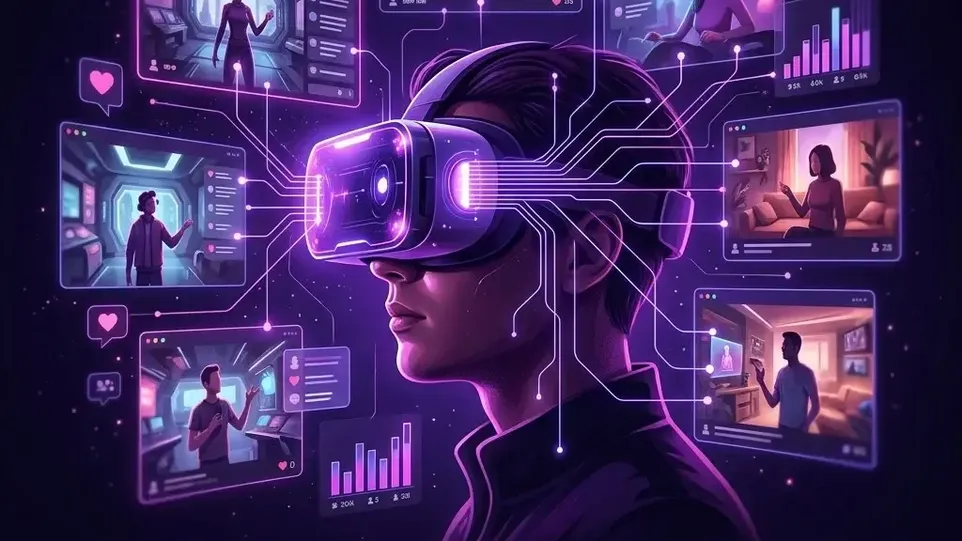
But when you put on a VR headset, something fundamentally different happens: your brain begins to accept the virtual environment as a real space you're inhabiting. Researchers at Stanford's Virtual Human Interaction Lab call this the "Sense of Presence" (SoP) — the feeling of genuinely "being there."
Once presence kicks in, three powerful psychological forces lock you in:
- Spatial immersion — your brain treats depth, proximity, and spatial audio as real
- Attentional capture — the full FOV eliminates distractions
- Cognitive exit cost — breaking presence requires conscious mental effort
The Science Behind Why Viewers Stay Longer
1. Full Field-of-View Eliminates Multi-Tasking
On a flat screen, you're one tab-click away from distraction. Email, social media, other tabs — the 2D cam show is competing with everything else on your screen and in your room.
VR headsets occupy your entire field of view. There are no other tabs. No phone notifications in your peripheral vision. No roommate walking past. Your brain has only one thing to focus on: the performer in front of you. This isn't just convenience — it's a fundamentally different attentional state that researchers call "environmental isolation."
2. Stereoscopic Depth Triggers Real Emotional Responses
Traditional cams are flat. VR cams use stereoscopic 3D rendering that gives you genuine depth perception. When a VR cam performer leans toward you, your brain processes this the same way it processes a real person leaning toward you in physical space.
Studies from the National Institutes of Health have shown that VR presence triggers genuine physiological responses: increased heart rate, pupil dilation, and measurable emotional arousal — the same responses you'd have during an actual in-person interaction.
3. Spatial Audio Creates Intimacy
VR cam platforms use binaural 3D audio that changes based on where you're looking. When a performer whispers, it sounds like they're actually next to your ear. When they move across the room, the sound follows. This spatial intimacy activates the same brain regions as real-world social proximity, creating a bond that 2D stereo audio simply cannot match.
4. Active Participation vs Passive Watching
In traditional camming, you're a passive spectator typing in a chat box. In VR, you're a participant. You can look around freely, establish "eye contact" with the performer, and feel a sense of shared space. This active participation creates psychological agency — the feeling that you're part of the experience, not just observing it.
VR Cams vs Traditional Cams: The Numbers
| Metric | 💻 Traditional 2D Cam | 🧿 VR Immersive Cam |
|---|---|---|
| Avg. Session Length | 7–12 minutes | 22–45 minutes |
| Viewer Role | Passive spectator | Active participant |
| Distraction Level | High (multi-tab, phone) | Near zero (full FOV) |
| Emotional Connection | Parasocial (screen-based) | Presence-based (spatial) |
| Sensory Input | 2D visual + stereo audio | Stereoscopic 3D + spatial audio |
| Tip/Token Rate | Standard | Higher per session |
| Return Rate | Moderate | Significantly higher |
The "Cognitive Exit Cost" — Why It's Hard to Leave VR
Here's the most fascinating part: once your brain achieves a state of presence in VR, breaking that presence requires conscious cognitive effort. Psychologists call this the "break cost" or "cognitive exit cost."
In a 2D cam session, leaving is effortless — you close a tab. But in VR, leaving means:
- Consciously deciding to break the immersive state
- Physically removing the headset
- Readjusting to your real environment
- Losing the sense of presence you've built up
This doesn't mean viewers are "trapped" — they can leave anytime. But the psychological friction to exit is significantly higher than clicking a close button, which naturally extends session times.
What This Means for Performers
For cam performers considering the jump to VR, the Presence Lock Effect has massive implications:
- Longer sessions = more revenue — viewers who stay 3x longer tip more
- Deeper connections = more regulars — presence creates genuine emotional bonds
- Premium positioning — VR cam performers can charge higher rates
- Less competition — far fewer performers in VR compared to traditional platforms
- Future-proofing — as headsets get cheaper and lighter, VR audiences will explode
What This Means for Viewers
If you've been curious about VR cams but haven't tried them yet, here's what to expect:
- It feels different — not just "better video," but a fundamentally different experience
- Time flies — you'll be surprised how quickly 30+ minutes pass
- Real connection — the sense of being in the same room is genuinely powerful
- Worth the gear — even a budget headset like the Pico 4 or Quest 3 delivers the effect
Already have a headset? Start exploring immersive VR content right now on xMonter:
The Future: Where VR Camming Is Headed
The Presence Lock Effect is only going to get stronger. Here's what's coming:
| Technology | Impact on Presence |
|---|---|
| Eye tracking | Real eye contact with performers — the ultimate intimacy upgrade |
| Haptic suits/gloves | Touch feedback adds a physical dimension to presence |
| AI-powered expressions | Performers' facial expressions tracked and rendered in real-time 3D |
| Higher resolution (12K+) | Eliminates screen-door effect, making VR indistinguishable from reality |
| Lighter headsets (<200g) | Removes physical discomfort, extending sessions even further |
| Interactive toy sync | Physical stimulation synchronized with visual presence |
📚 Related Articles on xMonter
- The Ultimate Guide to VR Porn for Beginners in 2026
- How to Watch VR Porn on Pico 4: Complete 2026 Setup Guide
- Pornstar Spotlight: Melody Marks — VR's Cosplay Queen
- Top 10 Most Watched VR Porn Videos on xMonter
Final Thoughts
The Presence Lock Effect isn't just a marketing buzzword — it's a measurable psychological phenomenon backed by neuroscience research from institutions like Stanford and the NIH. When VR tricks your brain into believing you're "really there," everything changes: attention deepens, emotions intensify, time perception shifts, and the cognitive cost of leaving increases.
For the adult cam industry, this represents a paradigm shift. Traditional 2D camming isn't going away, but VR camming offers something fundamentally different — not just better pixels, but a deeper human connection powered by the most sophisticated display technology ever created.
The future of intimate entertainment isn't on a screen. It's inside one. 🌟